
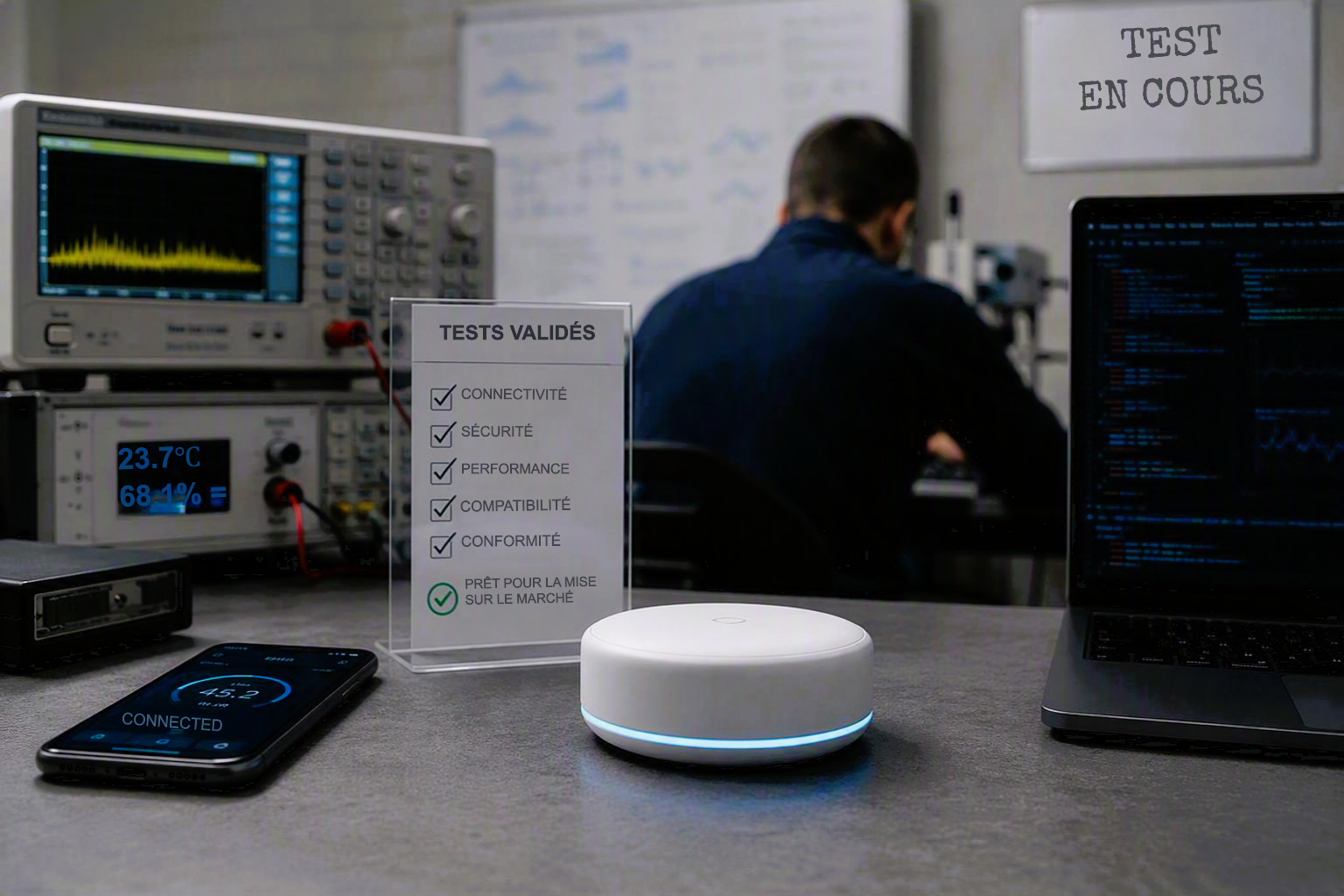
Essential tests before bringing a connected product to market
Connected objects, communicating industrial equipment, home automation devices, IoT systems—all these products share a common feature: before they can be marketed, they must demonstrate compliance with applicable regulatory and technical requirements.
For manufacturers, the stakes are twofold: ensuring the product's safety and proper functioning while securing market access. This involves several rounds of laboratory testing.
1. Electrical safety: protecting users
Electrical safety is one of the first steps in evaluating a connected product. The goal is to verify that the equipment poses no risk to the user under normal operating conditions or in the event of a foreseeable fault.Tests may cover aspects such as :
- Protection against electric shock
- Component heating
- Insulation distances
- Mechanical strength
- Risks associated with the power supply
2. Electromagnetic compatibility (EMC): avoiding interference
A connected product rarely operates in isolation; it must coexist with a multitude of other electrical and electronic devices. Electromagnetic compatibility (EMC) testing verifies that the product:- Does not generate excessive interference
- Is itself resistant to interference from its environment
- Maintains its performance under real-world operating conditions
3. Radio testing: ensuring reliable communication
Wi-Fi, Bluetooth, Zigbee, LTE-M, 5G, NFC—radio technologies are at the heart of many connected products today. Radio testing aims to verify:- Communication quality
- Transmission power
- Efficient use of the radio spectrum
- Compliance with applicable regulatory requirements.
4. Environmental testing: validating product robustness
A product that meets standards in the laboratory must also perform well in its actual operating environment. Environmental testing assesses how the product handles various stresses, such as:- high or low temperatures
- humidity
- vibration
- mechanical shock
- accelerated aging.
5. Performance testing: confirming product claims
Beyond regulatory requirements, manufacturers also want to demonstrate their products' performance. Depending on the technologies involved, testing can evaluate:- communication quality
- battery life
- transmission speed
- operational stability
- specific performance metrics expected by users
These measurements verify that the product meets the objectives set during the design phase. A comprehensive approach to secure market launch: project success relies not on a single test, but on a combination of complementary evaluations performed at the right stages of development.
With its specialized laboratories and teams, LCIE Bureau Veritas supports manufacturers in evaluating their connected products through a wide range of tests: electrical safety, EMC, radio, environmental, and performance.